Showing posts with label drug testing device. Show all posts

Monday, 7 January 2013

New Website! Online Store! Come visit us at Drug Test Australia

Drug Test Australia

Come see our newly updated website at www.drugtestaustralia.com.au

Our new online store has new products available in Saliva Drug Testing and Urine Drug Testing and a range of Breathalysers, as well we have our AS 4760 compliant device ToxSure II.

We offer nationally accredited Training Packages for delivery onsite or in our office.

Because health and safety is important to us, we source only the highest quality testing equipment from the US and deliver unsurpassed service and procedures in accordance with AS/NZS ISO 9001:2008, AS ISO 15189:2009. Equipment detection cut-off levels (the ng/ml level of substance in the system) are compliant to AS/NZS4308:2008 and AS4760-2006 and non-negative specimens are assessed only at NATA approved laboratories.


                          TOXSURE ORAL II                            Urine specimen cup

We provide information of Drugs and detection periods and Drug types, testing methods and drug testing standards


Drug Test Australia is committed to helping create safer workplaces and reducing the risks associated with alcohol and drugs of abuse.
We are a part of Hunter Healthcare Group, a corporate healthcare organisation with services spanning corporate immunisation, public and private hospitals, aged care nursing services and onsite occupational health.

Visit our website for more information, or to make a product enquiry.

If you have an enquiry you can contact us at sales@drugtestaustralia.com.au or call us on 1300 660 636

Thursday, 13 December 2012

Kiwi Kronic 'king' facing drug charges in Australia


New Zealand's "king" of legal cannabis faces trafficking charges in Australia after allegedly being found with a "commercial quantity" of drugs.
Matthew Wielenga was arrested about 8pm on Friday in the Melbourne suburb of Southbank. The 30-year-old is facing charges of trafficking a commercial quantity of synthetic cannabinoids and two counts of possessing a drug of dependence.
The Melbourne Magistrates Court yesterday heard he was found with more than 100kg of Kronic, a synthetic marijuana product, and 1kg of white powder said to be a synthetic cocaine sold as Diablo.
The alleged drugs are yet to be analysed and Wielenga had made no admissions, the court heard.
Defence lawyer Greg Barns said the elements of Kronic kept changing and might not fall within the substances banned by Victorian law.
Wielenga was granted bail on a A$100,000 surety and is to reappear in court on March 18.
Dressed in jeans and a dark T-shirt, he appeared to be listening intently throughout the court hearing.
The New Zealander must stay at an address in the suburb of Richmond, report to local police daily and surrender his passport.
Wielenga is a director of Lightyears Ahead, the company responsible for bringing Kronic to New Zealand. Kronic is laced with chemicals mimicking cannabis and is often much stronger than the real thing. It was banned in New Zealand in August.
Wielenga, who ran his lucrative Kronic empire from Albany on Auckland's North Shore, is understood to have travelled to Australia with about nine of his employees last week. The group were in Australia for a music festival, a source said.
Nisha Din, described as the general manager of Lightyears Ahead, said the firm strongly denied any illegal activity.
She referred the Herald to Wellington law firm Chen Palmer.
Partner Mai Chen did not return calls last night.
Wielenga describes his party pill business on his Facebook page: "I run my own company that provides products to get people high. They are sold all over the world, which gives me a great excuse to travel."
Anna Leask, NZ Herald

Sunday, 25 November 2012

Synthetic Drugs; Australian Crime Commission


Posted by Drug Test Australia

Original; http://www.crimecommission.gov.au/publications/illicit-drug-data-reports/2010-11/index/other-drugs#analogues

Main Forms

Drug analogues and other synthetic drugs have been present in Australia and overseas since at least the mid-2000s. Analogues available within the illicit drug market are variants of a parent compound which is usually a prohibited or scheduled drug. These substances are typically marketed as ‘legal highs’14 and used as substitutes for illicit drugs such as methylamphetamine and 3,4-methylenedioxymethylamphetamine (MDMA). In recent years, an analogue drug market has been established as users have increasingly sought out specific analogues rather than using them as substitutes.
A wide range of analogue and other synthetic drugs are available to users. Many of these substances are sourced from online ‘legal high’ stores, legitimate fine chemical suppliers and sites selling ‘research chemicals’. In some countries illicit cannabimimetics are marketed as ‘herbal smoking blends’; herbal incense and as ‘plant foods’ (TGA 2011).
A review of overseas online legal high stores identified up to 500 different analogue drugs being advertised. Analogues are frequently marketed as being natural and legal and are perceived by many users to be less harmful than illicit drugs. As many of these substances are novel, there is limited research or knowledge about the short or long-term health consequences of use, the risk of dependence, possible adverse effects of use in combination with other drugs, or potential fatal dosage levels.
In an attempt to circumvent legislative and regulatory measures, many of these substances are marketed under the guise of other products not intended for human consumption, such as bath salts, plant food, incense and room deodorisers. Further, to avoid detection, packaging may not accurately reflect the ingredients leaving users unaware of the true ingredients within. Even when ingredients are correctly listed, users may remain unaware of the related implications and effects of use.
Two groups of analogues and other synthetic drugs that have received considerable public attention during 2010–11 are cannabimimetics (which mimic cannabinoids) and cathinones, in particular 4-methylmethcathinone. This section covers these two groups in more detail.

Cannabimimetics

Cannabimimetics, also referred to as synthetic cannabinoids15, are synthetic chemicals which mimic the effects of tetrahydrocannabinol (THC)—the principal psychoactive component of the illicit drug cannabis. Analysis in a number of European countries identified a large number of chemicals which could be classed as cannabimimetics. While some cannabimimetics share a chemical structure similar to THC, the vast majority of identified to date have no structural relationship to THC (EMCDDA 2011d). With the exception of a small number of substances which have very limited legitimate uses, the vast majority of identified substances have no legitimate industrial, scientific or medicinal uses.
Cannabimimeticsthat have been used for medicinal purposes and are scheduled within the Standard for the Uniform Scheduling of Poisons (SUSMP) are:
  • Rimonabant (currently in Schedule 4): A selective CB1 receptor antagonist historically used to treat obesity, but was withdrawn from the market due to severe side effects
  • Nabilone (currently in Schedule 8): A synthetic cannabinoid used for treatment of anorexia and for its antiemetic effects; its chemical structure is closely related to THC
  • Dronabinol (currently in Schedule 8 for therapeutic use): Synthetically produced pure THC used in the treatment of multiple sclerosis and pain patients (TGA 2011).
Illicit cannabimimetics, commonly known as synthetic cannabis, consist of a combination of neutral plant materials, similar in appearance to cannabis, which have been sprayed with one or more synthetic cannabinoids. Synthetic cannabis is best known by the brand names ‘Kronic’, ‘Northern Lights’, ‘Spice’, ‘Kaos’, ‘Voodoo’ and ‘Mango’ (NSW Health 2011b; ACT Health 2011).
As packaging of synthetic cannabisrarely identifies the ingredients from which the substance is formulated (in particular the synthetic cannabinoid component), people dealing in synthetic cannabispreparations may be hindered in their ability to determine the legal status of the product. This potentially causes legal issues for importers, distributors, retailers and consumers (TGA 2011).
Synthetic cannabis, like natural cannabis, can cause memory and thinking impairment in small doses. Short-term effects from consuming synthetic cannabis can include fatigue, headaches, disorientation, hallucinations, high blood pressure, tachycardia, paranoia, agitation, restlessness, panic attacks, anxiety and depression (WADAA 2011). Heavy and regular use may cause hallucinations, confusion, anxiety, depression, paranoia, psychosis and heart palpitations (ACT Health 2011).
As synthetic cannabisis a manufactured substance, there can be considerable variety and quantity of substances present, resulting in unpredictability in the effects of use (NSW Health 2011b).

4-MMC (4-Methylmethcathinone)

An analogue which has received significant media and law enforcement attention is 4-methylmethcathinone (also known as 4-MMC or mephedrone). 4-MMC is a synthetic stimulant and an analogue of the drug methcathinone. It is known to produce central nervous system stimulation, psychoactivity and hallucinations (DEA 2011a). In Australia, there are no legal uses for 4-MMC and it is listed as a prohibited import under Schedule 4 of the Customs (Prohibited Imports) Regulations 1956 and is a Border Controlled Drug under Section 314.4 (2) of the Commonwealth Criminal Code Act 1995.
Other common names for 4-MMC include; meph, meow, miaow-miaow, m-cat, plant food, drone, bubbles and kitty cat. The most common form is an off-white or yellowish powder and it is also available in tablet or capsule form. The powder can be snorted or swallowed in bombs (wraps of paper). There has been limited reporting of injection as a form of administration of the drug (Sindicich & Burns 2011; ADF 2011d).
Users report that 4-MMC produces a similar experience to drugs such as amphetamines, ecstasy or cocaine. Reported effects include euphoria, increased energy and alertness, loss of appetite, dilated pupils, tremors or convulsions, insomnia, anxiety and paranoia. The long-term effects of 4-MMC are difficult to identify due to limited research in this area (ADF 2011d).

International Trends

In 2011, products containing new psychoactive substances became available in many parts of the world, including the Americas, the Middle East, Oceania and parts of Asia. Many countries are now facing the challenge of identifying an ever‑increasing range of substances in a rapidly changing market (EMCDDA 2011a).
In 2010, the US Drug Enforcement Agency reported that an estimated 2 977 samples of synthetic cannabinoids were submitted to State and local forensic laboratories in the US. This was a considerable increase from the estimated 15 synthetic cannabinoid samples identified during 2009. In 2010, nearly two-thirds of these samples were identified as JWH-01816 (63 per cent) and about one-quarter as either JWH-25017 (14 per cent) or JWH-07318 (9 per cent) (DEA 2011d).
Europe continues to see an increase in new synthetic substances with a total of 41 new synthetic psychoactive substances reported to the European Early Warning System in 2010 (Europol 2011). Of the 41 new psychoactive substances identified in 2010, 15 were synthetic cathinones and 11 were synthetic cannabinoids(EMCDDA 2011a; Europol 2011)
The 2010–11 British Crime Survey of UK residents reported that respondents aged 16–24 years of age had the highest rates of synthetic cannabinoids use. Among 16–59 year olds, the proportion of respondents reporting 4-MMC use was equal to the proportion reporting ecstasy use (1.4 per cent) and in the 16–24 years age group, the proportion was equal to powder cocaine use (4.4 per cent) (Smith & Flatley 2011). An online survey targeting club-goers in the UK found that 4-MMC was the fourth most commonly used drug (after cannabis, ecstasy and cocaine) among the 2 295 respondents (EMCDDA 2010).
In 2010–11, the increasing variety and expanding market in analogues saw many countries—including Australia—take steps to prohibit their importation, sale and use. In some countries, including the US and New Zealand, synthetic cannabinoids have been temporarily categorised as controlled substances as these governments seek to appropriately amend legislation to ensure that all current and emerging cannabimimetics are captured.
As of December 2010, the US Drug Enforcement Administration (DEA) banned five synthetic cannabinoids by placing them in Schedule I under the Controlled Substances Act, which is for substances considered to have a high potential for abuse and no known medical benefits. This ban will continue for a year, making it illegal to possess or sell products that contain synthetic cannabinoids and allowing the DEA time to gather information regarding these five synthetic cannabinoids (DEA 2011b).
In 2011, the New Zealand Government approved amendments to the Misuse of Drugs Act 1975, creating a new mechanism to place a temporary ban on unregulated substances of concern. This new mechanism enabled the New Zealand Minister for Health to place a 12-month ban on any current or emerging synthetic cannabinoids. The New Zealand Government intends to implement recommendations from the New Zealand Law Commission that reverse the onus of proof, requiring industry to prove its products are safe (NZ Government 2011).
In response to potential health concerns, Austria, Germany, France, Luxembourg, Poland, Lithuania, Sweden and Estonia have taken legal action to ban or otherwise control synthetic cannabis products and related compounds. In December 2010, while mephedrone was banned in the countries of the EU it is still available in illicit drug markets (UNODC 2011a).

Domestic Market Indicators

In 2011, the Australian Government announced the addition of eight synthetic cannabis compounds to Schedule 9 of the SUSMP. The eight synthetic cannabis compounds were scheduled on the basis that they are used for the purpose of obtaining a psychoactive effect, may be dependence producing, have no legitimate therapeutic uses and have documented harmful effects which may be significant in some individuals (TGA 2011). Several synthetic cannabis compounds were added to state and territory legislation during 2010–11 (see State and territory legislative amendments and initiatives chapter).
4–MMC is a prohibited import under the Schedule 4 of the Customs (Prohibited Imports) Regulations Act 1956 and is a Border Controlled Drug under the Commonwelth Criminal Code Act 1995. On 9 April 2011, 4–MMC became a prescribed substance under the Criminal Code Regulations Act 2002.
The extent of synthetic cannabis use among the general population in Australia is currently unknown.
According to a 2010 study of regular ecstasy users, 16 per cent of respondents reported recent use (in the last 6 months) of 4MMC, while 18 per cent reported in lifetime use. Recent 4–MMC use was reported primarily in Tasmania and Victoria. Snorting, followed by swallowing, was the most common method of administration, with minimal reporting of smoking and injecting 4MMC (Sindicich & Burns 2011). Early findings from the 2011 study indicate a small decline in recent use, with only13 per cent reporting recent use of 4-MMC (NDARC 2011d).

Price

Law enforcement price data for synthetic cannabis and 4-MMC is limited. In Tasmania in 2010–11, a cap of 4-MMC ranged between $15 and $50. The price of one gram of synthetic cannabis leaf in Queensland ranged between $20 and $30.
Contact us;
Website; www.drugtestaustralia.com.au
Email; Sales@drugtestaustralia.com.au
Phone; 1300 660 636

Lack of testing leads to Kronic problem: NZ Emergency Doctor

Posted by Drug Test Australia

Original; Emma Dawe, The Southland Times; http://www.stuff.co.nz/southland-times/news/5264514/Lack-of-testing-leads-to-Kronic-problem-emergency-doctor


An emergency physician believes people are using party drugs, including Kronic, under the misguided belief they have been rigorously tested by authorities.
Paul Gee, from Christchurch Hospital, said that was not the case at all and party drugs were actually in a "twilight zone" between legal and illegal drugs because they were not covered by legislation.

"They're not a named drug covered by legislation. Nor are they a food, so they escape legislation covering foods.
"They're being slickly marketed and people are buying them not realising they've never been tested before in humans."
Speaking at the winter symposium of the Australasian College for Emergency Medicine held in Queenstown yesterday, Dr Gee called for the onus to be put on manufacturers to prove new psychotropic drugs were safe.
"At present we have to wait until people reach intensive care before there is any action."
The herbal ingredients in the products were mixed with unlisted synthetic Cannabinoids that had been declared illegal in some countries but were unregulated in New Zealand.
Dr Gee said he was seeing more patients affected by the drugs – those patients were showing symptoms similar to those of people using cannabis, such as drowsiness, increased heart rate and feelings of euphoria.
Those symptoms were what doctors had expected, but what was not expected were the amphetamine-type symptoms some party drug users were displaying, including seizures, he said.
"We've seen some people probably close to unconsciousness," he said.
While it was too soon to determine what the long-term effects of using the drugs were, Dr Gee said there was evidence prolonged cannabis use could lead to long-term memory loss, and there was no reason why that would not be the case for the prolonged use of party drugs.
Dr Gee said his main concern was nobody had done any scientific research on the drugs.
While any new food or medicine was stringently tested before being licensed for consumption in New Zealand, the chemicals in these substances were not.
"It basically amounts to experimentation but without the upside of gathering any information."
Meanwhile, former Central Otago District Mayor Malcolm Macpherson is calling for people to join him in a footpath demonstration outside the only shop in Alexandra selling Kronic – C&C Traders.
Mr Macpherson said there was no justification for the owner to sell Kronic, and other products that exposed the community to health risks.
C&C Traders owner Bill Clements said he was being "pushed into a corner" for no reason, as the products were not to blame for the problems parents were having with their teenagers.
Contact us at Drug Test Australia
Website; www.drugtestaustralia.com.au
Email; Sales@drugtestaustralia.com.au
Phone; 1300 660 636

Workers attempt to hide drug use

Posted by Drug Test Australia
Original By DONNA PAGE, Nov. 26, 2012, 4:21 a.m.  http://www.theherald.com.au/story/1144689/poll-workers-attempt-to-hide-drug-use/?cs=311


HUNTER workers are using a range of new and sophisticated masking and detox agents to 

HUNTER workers are using a range of new and sophisticated masking and detox agents to avoid detection in workplace drug tests.
The products come in a range of forms, including drinks, tablets, mouthwash and capsules, and range in price from $50 to $200.A Newcastle Herald investigation has found workers in a range of industries, including drivers, machinery operators, explosive technicians, miners and contractors using the products that can be bought online or at some Hunter stores.
Mayfield’s Drug Test Australia general manager Tom Somerville said workplace drug and alcohol testing had ‘‘exploded’’ in the Hunter over the past two years.
The most common drug detected was cannabis, followed by opiates.
Mr Somerville said he was aware of a ‘‘range of techniques’’ used by people in an effort to avoid detection.
But ‘‘high quality’’ Australian standard test kits, as used by his firm, could detect many masking agents and synthetic cannabis.
‘‘Technology has caught up in recent months and the testing products are far more sophisticated,’’ he said.
Workers told the Herald several products were effective in passing urine tests just hours after smoking cannabis or using other illegal and synthetic drugs. Most worked within an hour and lasted for up to eight hours.
Six users said they had used readily available masking agents or detox kits to pass urine and saliva tests that they would have otherwise failed.
A Merewether man said he passed a pre-employment medical carried out by a doctor, that included a urine drug test, after smoking cannabis daily for six months.
Cannabis can be detected in urine up to a month after use.
‘‘I tested myself after using a flushing kit months before I was offered the job and it worked perfectly, so I did the same thing again and I passed,’’ he said.
But Mr Somerville said workers were ‘‘dreaming’’ if they thought masking agents or detox kits were going to ensure they passed all tests.
‘‘My understanding is these things take some time to take effect and most workers have no idea they are going to be tested when they turn up to work, it’s random,’’ he said.
‘‘They might be able to use masking agents once or twice and get lucky with some forms of testing, but they will get caught.’’
Mr Somerville said there had been a shift in recent months away from urine testing to saliva testing.
‘‘Saliva testing is used to detect [skills] impairment, while urine testing will show [a drug’s] presence,’’ he said.
Construction, Forestry, Mining and Energy Union northern district president Peter Jordan said he believed many coal industry employers, one of the last industries in the Hunter to use widespread urine testing, wanted to ‘‘know what employees get up to in their own time’’.
Coal companies say testing is necessary to ensure a safe working environment. He was aware of employees being caught using masking agents or tampering with urine samples.
Mr Jordan said employees who failed one test could be targeted for testing at any time.

‘‘They will resist any attempt to implement more socially acceptable procedures like saliva testing ... We believe saliva testing can provide appropriate and sufficient information to a company in the event an employee is impaired. What you get up to in your own time, is your own business.’’‘‘My view is that employers in the coal industry who use urine testing will attempt to hold onto that testing at whatever cost,’’ he said.
Contact us at Drug Test Australia
Website; www.drugtestaustralia.com.au
Email; Sales@drugtestaustralia.com.au
Phone; 1300 660 636

Monday, 12 November 2012

Legalizing marijuana created a rippling effect

Posted by Drug Test Australia
Original at http://www.gazette.com/articles/marijuana-147208-rippling-created.html


Medical marijuana is packaged for sale in 1-gram packages at the Northwest Patient Resource Center medical marijuana dispensary, Wednesday, Nov. 7, 2012, in Seattle. After voters weighed in on election day, Colorado and Washington became the first states to allow possession of up to 1 oz. of legal pot for recreational use, but they are likely to face resistance from federal regulations.


The famous — or infamous, depending on your point of view — ballot measure legalizing marijuana in Tuesday’s election is already sending ripples through Colorado’s medical marijuana community.
Some medical marijuana dispensaries are worried, some aren't. Some dispensaries supported the ballot measure, some didn't.
But one thing is for sure — they've all gotten a lot more attention since the ballot measure has made national news.
“One centre owner I know said somebody from Chicago called up and asked if they could send them a pound in the mail,” said Jeff Sveinsson, the owner of Cannabicare, a medical marijuana dispensary near Peterson Air Force Base.
Tanya Garduno, president of the Colorado Springs Medical Cannabis Council, said her phone “has been ringing off the hook” with calls from centers all over Colorado.
Center owners, she said, are being hassled by people from not just Colorado Springs but by people from Durango, Pueblo, Denver and in other towns who want to buy pot.
“It’s pretty hilarious when I get those problems,” Garduno said. “Every centre has been swamped with calls, ‘Can I buy now?’ ‘No, you can’t.’ ”
Amendment 64, which Colorado voters approved Tuesday by a 55 percent margin, will allow individuals older than 21 to possess as much as an ounce of marijuana and grow as many as six marijuana plants. It will also allow retail marijuana stores to open in January 2014, after the Legislature enacts industry regulations.
Many people around the country haven’t read the fine print, though. Personal possession will only become legal after the governor proclaims the amendment part of the state Constitution, which may not happen until the governor’s deadline, Jan. 5.
That isn't just an annoyance, Sveinsson said. It points to a serious flaw in the amendment — the measure doesn’t specify whether only Colorado residents can buy recreational marijuana.
“We’ve had people calling our store all week long who are from out of state, who are going on road trips and want to buy marijuana from us,” Sveinsson said.
“We’re going to be (angering) Nebraska, Kansas, Illinois, you name it.”
Sveinsson is only one of dozens of medical marijuana stakeholders around Colorado Springs, though, and plenty of others have no problem with the amendment.

Gina Akeo, the manager of the medical marijuana center Natural Leaf, said she voted for it because of the criminal repercussions.
“If you’re going to legalize alcohol, which kills thousands of people a year, and not legalize something that’s never harmed anyone, that’s counter-productive,” Akeo said. “The feds shouldn't be wasting time on people that are committing minor crimes like having less than an ounce of pot.”
Akeo said that plenty of her patients also voted for Amendment 64 for the same reason.
But they, and Akeo, still have reservations.
“It’s also a medical thing, and to make it recreational kind of defeats the purpose. It’s kind of a Catch-22,” Akeo said. “A lot of patients don’t want people with minor amounts incarcerated, but they also don’t want their medical to be interfered with.”
For those reasons and more, Garduno said, the Medical Cannabis Council planned a meeting to discuss the issue. The council has more than 60 members, she said, including dispensary owners, employees, patients and doctors.
“Most of the folks are kind of split down the centre. Half of them say they’re in favour of going legal, and half want to stay patient-based,” Garduno said.
And some are furious, like Sveinsson.
“We’re going to become the Amsterdam of the United States,” he said. “I can guarantee that (buyers) will be offloading it onto the streets and sending it out of state.”
Some dispensaries will probably be interested in selling both recreational marijuana and medical, Garduno said, because they’ve already set up shop and could make more profits if they add to their clientele.
That depends largely on what kind of rules the Legislature puts out, Akeo said. Her shop hasn’t even considered yet whether or not it may sell recreational marijuana, because they wouldn’t have to apply for a license until 2014.
“We knew we’d better hurry up and wait, just like we did with medical. It’s like, what’s going to happen now?” Garduno said.
Medical marijuana, Garduno and Akeo pointed out, was approved by Colorado voters in 2000, but regulations are still being handed down by the state. Centres have had to relocate, update security systems, and more. Regulations for recreational stores could take longer and be even more stringent.
Other stakeholders in the industry are also talking about what may happen if the federal government decides to prosecute stores that begin selling recreational marijuana. Marijuana may be legal in Colorado, but remains banned under federal law.
The federal government has shut down medical marijuana dispensaries in other states, like California, and some warn that the same thing could happen here if Amendment 64 leads to federal intervention.
WHEN LEGAL?
Personal possession of marijuana will only become legal after Colorado Gov. John Hickenlooper proclaims the amendment part of the state Constitution, which might not happen until the governor's deadline, Jan. 5, 2013.

A medical marijuana plant is shown at the Northwest Patient Resource Center medical marijuana dispensary, Wednesday, Nov. 7, 2012, in Seattle. After voters weighed in on election day, Colorado and Washington became the first states to allow legal pot for recreational use, but they are likely to face resistance from federal regulations. 

Read more: http://www.gazette.com/articles/marijuana-147208-rippling-created.html#ixzz2C403sLJV

Contact us at Drug Test Australia
Website; www.drugtestaustralia.com.au
Email; Sales@drugtestaustralia.com.au
Phone; 1300 660 636

Thursday, 1 November 2012

What are the long-term effects of methamphetamine abuse?


Posted by Drug Test Australia

Article from; National Institute on Drug Abuse www.drugabuse.gov

Methamphetamine Abuse and Addiction


Long-term methamphetamine abuse has many negative consequences, including addiction. Addiction is a chronic, relapsing disease, characterized by compulsive drug seeking and use, accompanied by functional and molecular changes in the brain. In addition to being addicted to methamphetamine, chronic abusers exhibit symptoms that can include anxiety, confusion, insomnia, mood disturbances, and violent behavior. They also can display a number of psychotic features, including paranoia, visual and auditory hallucinations, and delusions (for example, the sensation of insects creeping under the skin). Psychotic symptoms can sometimes last for months or years after methamphetamine abuse has ceased, and stress has been shown to precipitate spontaneous recurrence of methamphetamine psychosis in formerly psychotic methamphetamine abusers.
With chronic abuse, tolerance to methamphetamine's pleasurable effects can develop. In an effort to intensify the desired effects, abusers may take higher doses of the drug, take it more frequently, or change their method of drug intake. Withdrawal from methamphetamine occurs when a chronic abuser stops taking the drug; symptoms of withdrawal include depression, anxiety, fatigue, and an intense craving for the drug.
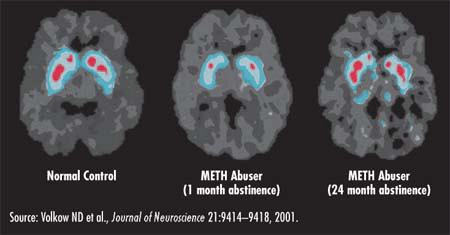
PET images showing damage to Dopamine transporters in a meth abuser after 1 months abstinence,  significant reduction in activity compared to normal brain, but after 24 months abstinence,  transporters have nearly returned to normal
Recovery of Brain Dopamine Transporters in Chronic Methamphetamine (METH) Abusers

Chronic methamphetamine abuse also significantly changes the brain. Specifically, brain imaging studies have demonstrated alterations in the activity of the dopamine system that are associated with reduced motor speed and impaired verbal learning. Recent studies in chronic methamphetamine abusers have also revealed severe structural and functional changes in areas of the brain associated with emotion and memory, which may account for many of the emotional and cognitive problems observed in chronic methamphetamine abusers.
Fortunately, some of the effects of chronic methamphetamine abuse appear to be, at least partially, reversible. A recent neuroimaging study showed recovery in some brain regions following prolonged abstinence (2 years, but not 6 months). This was associated with improved performance on motor and verbal memory tests. However, function in other brain regions did not display recovery even after 2 years of abstinence, indicating that some methamphetamine-induced changes are very long-lasting. Moreover, the increased risk of stroke from the abuse of methamphetamine can lead to irreversible damage to the brain.

Long-term effects may include:

  • Addiction
  • Psychosis, including:
    • paranoia
    • hallucinations
    • repetitive motor activity
  • Changes in brain structure and function
  • Memory Loss
  • Aggressive or violent behavior
  • Mood disturbances
  • Severe dental problems
  • Weight loss
Contact us at Drug Test Australia
Website; www.drugtestaustralia.com.au
Email; Sales@drugtestaustralia.com.au
Phone; 1300 660 636