Showing posts with label info about drugs. Show all posts

Thursday, 13 December 2012

Kiwi Kronic 'king' facing drug charges in Australia


New Zealand's "king" of legal cannabis faces trafficking charges in Australia after allegedly being found with a "commercial quantity" of drugs.
Matthew Wielenga was arrested about 8pm on Friday in the Melbourne suburb of Southbank. The 30-year-old is facing charges of trafficking a commercial quantity of synthetic cannabinoids and two counts of possessing a drug of dependence.
The Melbourne Magistrates Court yesterday heard he was found with more than 100kg of Kronic, a synthetic marijuana product, and 1kg of white powder said to be a synthetic cocaine sold as Diablo.
The alleged drugs are yet to be analysed and Wielenga had made no admissions, the court heard.
Defence lawyer Greg Barns said the elements of Kronic kept changing and might not fall within the substances banned by Victorian law.
Wielenga was granted bail on a A$100,000 surety and is to reappear in court on March 18.
Dressed in jeans and a dark T-shirt, he appeared to be listening intently throughout the court hearing.
The New Zealander must stay at an address in the suburb of Richmond, report to local police daily and surrender his passport.
Wielenga is a director of Lightyears Ahead, the company responsible for bringing Kronic to New Zealand. Kronic is laced with chemicals mimicking cannabis and is often much stronger than the real thing. It was banned in New Zealand in August.
Wielenga, who ran his lucrative Kronic empire from Albany on Auckland's North Shore, is understood to have travelled to Australia with about nine of his employees last week. The group were in Australia for a music festival, a source said.
Nisha Din, described as the general manager of Lightyears Ahead, said the firm strongly denied any illegal activity.
She referred the Herald to Wellington law firm Chen Palmer.
Partner Mai Chen did not return calls last night.
Wielenga describes his party pill business on his Facebook page: "I run my own company that provides products to get people high. They are sold all over the world, which gives me a great excuse to travel."
Anna Leask, NZ Herald

Monday, 19 November 2012

University students turn to ADHD drugs

Posted by; Drug Test Australia

Original By Daniel Piotrows,http://www.news.com.au/lifestyle/health-fitness/high-marks-uni-students-turn-to-add-drugs/story-fneuz9ev-1226519836513#ixzz2Cie9EJO7

High marks
University Students turning to ADHD medication to help them cope with their studies
UNIVERSITY students are taking ADHD medication to help them cope with their studies, a first-of-its-kind research paper has found.

The students are using prescription amphetamines like Ritalin to help stay awake and alert, particularly when "cramming" for exams and assessments, the report from Victoria's Deakin University says.

The paper's author and senior lecturer in public health, Dr Matthew Dunn, said students were using the medication as well as caffeinated drinks and even illicit drugs to cope with increasing time pressures.
"People are taking things which keep them awake so they can balance either a full-time uni or job workload with a social life," Dr Dunn said. 

"If you're paying thousands of dollars to study, you want to do well. For some people there may be the allure of using something a little bit stronger to get the best result."

Professor Barbara Pocock, director of the Centre of Work and Life at the University of South Australia, said over the past 20 years there had been a significant shift in the number of students supporting themselves financially while studying.

Undergraduate students often had to balance their studies with up to 25 hours a week of paid work with studies showing this could place them under more pressure than many full-time workers, Prof Pocock said. 

"Their pressures are quite often significant and worse than a lot of workers," she said, noting that many students ran their own households. 

Despite this, clinical professor and adolescent psychiatrist Jon Jureindi said there was not a lot of evidence Ritalin-type drugs help students absorb information. 

"Students probably feel these drugs increase attention – and they decrease purposeless activity – but there's no evidence they increase learning," he said.

The drugs can also have physiological and psychological side effects, even triggering anxiety and psychosis in some people.

Heather*, 22, has taken an ADHD drug, dexamphetamine, to help her study since Year 10. She works fulltime and is studying a postgraduate degree in business.

"What it does is let you concentrate harder and longer," she said. "I tend to get three times the work done after I take a dex."

She said that it would be difficult to manage studying, working and being social without help.

"I don't see it as too different from cracking open a couple of Red Bulls or drinking several coffees to pull of an all-nighter," she said.

She does admit she sometimes feels quite tired after consuming the pills. 

The Deakin University study of 655 students at Victoria's Deakin University reported 7.3 per cent used prescription amphetamines - a lower rate of prescription amphetamine consumption by Australian students than American students but more research was needed.

Dr Dunn will present his report's findings at the Australasian Professional Society on Alcohol and Other Drugs (APSAD) conference in Melbourne on Wednesday. 

* Not her real name

Contact us at Drug Test Australia
Website; www.drugtestaustralia.com.au
Email; Sales@drugtestaustralia.com.au
Phone; 1300 660 636

Sunday, 18 November 2012

Workers Drug & Alcohol Consumption by Industry

Posted by Drug Test Australia;

Workers' Drug & Alcohol Consumption by Industry

Research undertaken by The National Centre for Education and Training on Addiction, NCETA, Australia's national research centre on alcohol and other drugs workforce development, has identified that alcohol and drug consumption patterns vary substantially between industries and occupations.  This data is important for the design of targeted interventions. The following tables outline some of these differences identified from a secondary analysis of 2004 National Drug Strategy Household Survey data:

Proportions of workers who have used an illicit drug at least once in the past 12 months or drink at risky levels ( >6 standard drinks for males; >5 standard drinks for females) weekly or more often by industry

Industry
Drugs
Industry
Alcohol
Hospitality
31.8%
Hospitality
16.0%
Construction
24.2%
Wholesale
14.4%
Retail
20.7%
Construction
14.3%
Transport
18.3%
Agriculture
12.6%
Finance
17.4%
Retail
11.0%
Manufacturing
17.2%
Manufacturing
9.9%
Wholesale
16.4%
Transport
9.5%
Agriculture
15.8%
Mining
9.2%
Services
15.1%
Services
8.0%
Administration
12.4%
Finance
7.9%
Mining
12.0%
Administration
7.4%
Education
9.2%
Education
3.2%
All workers
17.5%
All workers
9.4%


For more information, see original article at: http://nceta.flinders.edu.au/workplace/key-issues/workers-patterns-of-aod-consumption-by-industry-and-occupation/

Contact us at Drug Test Australia
Website; www.drugtestaustralia.com.au
Email; Sales@drugtestaustralia.com.au
Phone; 1300 660 636

Thursday, 15 November 2012

Altering the Mind; Hallucinogens You Haven't Heard Of

Posted by Drug Test Australia
Original; http://www.livescience.com/16286-hallucinogens-lsd-mushrooms-ecstasy-history.html

Ayahuasca

Ayahuasca is a hallucinatory mixture of Amazonian infusions centred around the Banisteriopsis caapi vine. The brew has long been used by native South American tribes for spiritual rituals and healing, and like other hallucinogens, ayahuasca often triggers very intense emotional experiences (vomiting is also common). In 2006, National Geographic writer Kira Salak described her experience with ayahuasca in Peru for the magazine.

"I will never forget what it was like. The overwhelming misery. The certainty of never-ending suffering. No one to help you, no way to escape. Everywhere I looked: darkness so thick that the idea of light seemed inconceivable," Salak wrote. "Suddenly, I swirled down a tunnel of fire, wailing figures calling out to me in agony, begging me to save them. Others tried to terrorize me. 'You will never leave here,' they said. 'Never, Never.'

Nonetheless, Salak wrote, when she broke free of her hallucinations, her crippling depression was alleviated. Its anecdotal experiences like this that have led researchers to investigate the uses of hallucinogens as therapy for mental disorders such as anxiety, depression and post-traumatic stress disorder.

Ayahuasca, made from the vine Banisteriopsis caapi

Peyote

Peyote is a cactus that gets its hallucinatory power from mescaline. Like most hallucinogens, mescaline binds to serotonin receptors in the brain, producing heightened sensations and kaleidoscopic visions.

Native groups in Mexico have used peyote in ceremonies for thousands of years, and other mescaline-producing cacti have long been used by South American tribes for their rituals.

Peyote has been the subject of many a court battle because of its role in religious practice; currently, Arizona, Colorado, New Mexico, Nevada and Oregon allow some peyote possession, but only if linked to religious ceremonies, according to Arizona's Peyote Way Church of God.

Peyote Cactus

'Magic' Mushrooms

The "magic" ingredient in hallucinogenic mushrooms is psilocybin, a compound that breaks down into psilocin in the body. Psilocin bonds to serotonin receptors all over the brain, and can cause hallucinations as well as synesthesia, or the mixture of two senses. Under the influence, for example, a person might feel that they can smell colours.

People have been ingesting psilocybin-continuing mushrooms for thousands of years. Synthetic psilocybin is now under study as a potential treatment for anxiety, depression and addiction.

'Magic' Mushroom, containing Psilocybin
PCP

Best known by its street name, "angel dust," PCP stands for phencyclidine. The drug blocks receptors in the brain for the neurotransmitter glutamate. It's more dangerous than other hallucinogens, with schizophrenia-like symptoms and nasty side effects.

Those side effects are why PCP has no medical uses. The drug was tested as an anaesthetic in the 1950s and used briefly to knock out animals during veterinary surgeries.

But by the 1960s, PCP had hit the streets and was being used as a recreation drug, famous for the feelings of euphoria and invincibility it bestowed on the user. Unfortunately, a side effect of all that euphoria is sometimes truly destructive behaviour, including users trying to jump out of windows or otherwise self-mutilating. Not to mention that high enough doses can cause convulsions.

PCP

Ibogaine

Derived from the African iboga plant, ibogaine is another hallucinogen with a long history of tribal use. More recently, the drug has shown promise in treating addiction, although mostly in Mexico and Europe where ibogaine treatment is not prohibited as it is in the U.S.

Using ibogaine as therapy is tricky, however. The drug can cause heart rhythm problems, and vomiting is a common side effect. The Massachusetts-based Multidisciplinary Association for Psychedelic Research (MAPS) reports that an estimated 1 in 300 ibogaine users die due to the drug.

The group is studying the long-term effects of ibogaine on patients in drug treatment programs in New Zealand and Mexico.

Ibogaine

Salvia divinorum
Salvia divinorum, also known as seer's or diviner's sage, grows in the cloud forest of Oaxaca, Mexico. The native Mazatec people have long used tea made out of the leaves in spiritual ceremonies, but the plant can also be smoked or chewed for its hallucinogenic effects.

Salvia is not currently a controlled substance, according to the National Institute on Drug Abuse, but it is under consideration to be made illegal and placed in the same drug class as marijuana.

Salvia divinorum
MDMA

Ecstasy, "E" or "X" are the street names for MDMA, or (get ready for a long one) 3,4-methylenedioxymethamphetamine. The drug acts on serotonin in the brain, causing feelings of euphoria, energy and distortions of perception. It can also nudge body temperatures up, raising the risk of heat stroke. Animal studies suggest that MDMA causes long-term and potentially dangerous changes in the brain, according to the National Institute on Drug Abuse.

MDMA was first synthesized by a chemist looking for substances to stop bleeding in 1912. No one paid the compound much mind for the next half-decade, but by the 1970s, MDMA had hit the streets. It was popular at raves and nightclubs and among those who liked their music psychedelic. Today, ecstasy is still a common street drug, but researchers are investigating whether MDMA could be used to treat post-traumatic stress disorder and cancer-related anxiety.

MDMA

Contact us at Drug Test Australia
Website; www.drugtestaustralia.com.au
Email; Sales@drugtestaustralia.com.au
Phone; 1300 660 636

Thursday, 1 November 2012

What are the long-term effects of methamphetamine abuse?


Posted by Drug Test Australia

Article from; National Institute on Drug Abuse www.drugabuse.gov

Methamphetamine Abuse and Addiction


Long-term methamphetamine abuse has many negative consequences, including addiction. Addiction is a chronic, relapsing disease, characterized by compulsive drug seeking and use, accompanied by functional and molecular changes in the brain. In addition to being addicted to methamphetamine, chronic abusers exhibit symptoms that can include anxiety, confusion, insomnia, mood disturbances, and violent behavior. They also can display a number of psychotic features, including paranoia, visual and auditory hallucinations, and delusions (for example, the sensation of insects creeping under the skin). Psychotic symptoms can sometimes last for months or years after methamphetamine abuse has ceased, and stress has been shown to precipitate spontaneous recurrence of methamphetamine psychosis in formerly psychotic methamphetamine abusers.
With chronic abuse, tolerance to methamphetamine's pleasurable effects can develop. In an effort to intensify the desired effects, abusers may take higher doses of the drug, take it more frequently, or change their method of drug intake. Withdrawal from methamphetamine occurs when a chronic abuser stops taking the drug; symptoms of withdrawal include depression, anxiety, fatigue, and an intense craving for the drug.
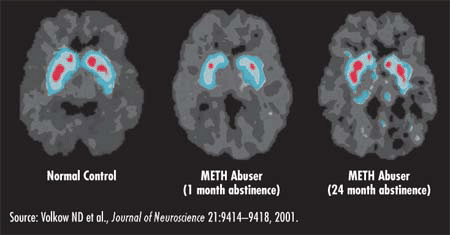
PET images showing damage to Dopamine transporters in a meth abuser after 1 months abstinence,  significant reduction in activity compared to normal brain, but after 24 months abstinence,  transporters have nearly returned to normal
Recovery of Brain Dopamine Transporters in Chronic Methamphetamine (METH) Abusers

Chronic methamphetamine abuse also significantly changes the brain. Specifically, brain imaging studies have demonstrated alterations in the activity of the dopamine system that are associated with reduced motor speed and impaired verbal learning. Recent studies in chronic methamphetamine abusers have also revealed severe structural and functional changes in areas of the brain associated with emotion and memory, which may account for many of the emotional and cognitive problems observed in chronic methamphetamine abusers.
Fortunately, some of the effects of chronic methamphetamine abuse appear to be, at least partially, reversible. A recent neuroimaging study showed recovery in some brain regions following prolonged abstinence (2 years, but not 6 months). This was associated with improved performance on motor and verbal memory tests. However, function in other brain regions did not display recovery even after 2 years of abstinence, indicating that some methamphetamine-induced changes are very long-lasting. Moreover, the increased risk of stroke from the abuse of methamphetamine can lead to irreversible damage to the brain.

Long-term effects may include:

  • Addiction
  • Psychosis, including:
    • paranoia
    • hallucinations
    • repetitive motor activity
  • Changes in brain structure and function
  • Memory Loss
  • Aggressive or violent behavior
  • Mood disturbances
  • Severe dental problems
  • Weight loss
Contact us at Drug Test Australia
Website; www.drugtestaustralia.com.au
Email; Sales@drugtestaustralia.com.au
Phone; 1300 660 636